GRAMMAR TOOLS

Japanese Transitive
& Intransitive Verbs

他動詞たどうし・ 自動詞じどうし

Japanese often has two different verbs for the same kind of change: one describes what happens, and the other describes what someone does.

FURIGANA

01

What’s the Difference?

Start with one simple idea.

INTRANSITIVE

自動詞じどうし

Something happens or changes.

ドアが あきます。

The door opens.

VS.
TRANSITIVE

他動詞たどうし

Someone does something to something.

さくらさんが ドアを あけます。

Sakura opens the door.

WHAT HAPPENS?
or
WHO DOES IT?

02

Same Situation, Two Sentences

Look at who — or what — is doing the changing.
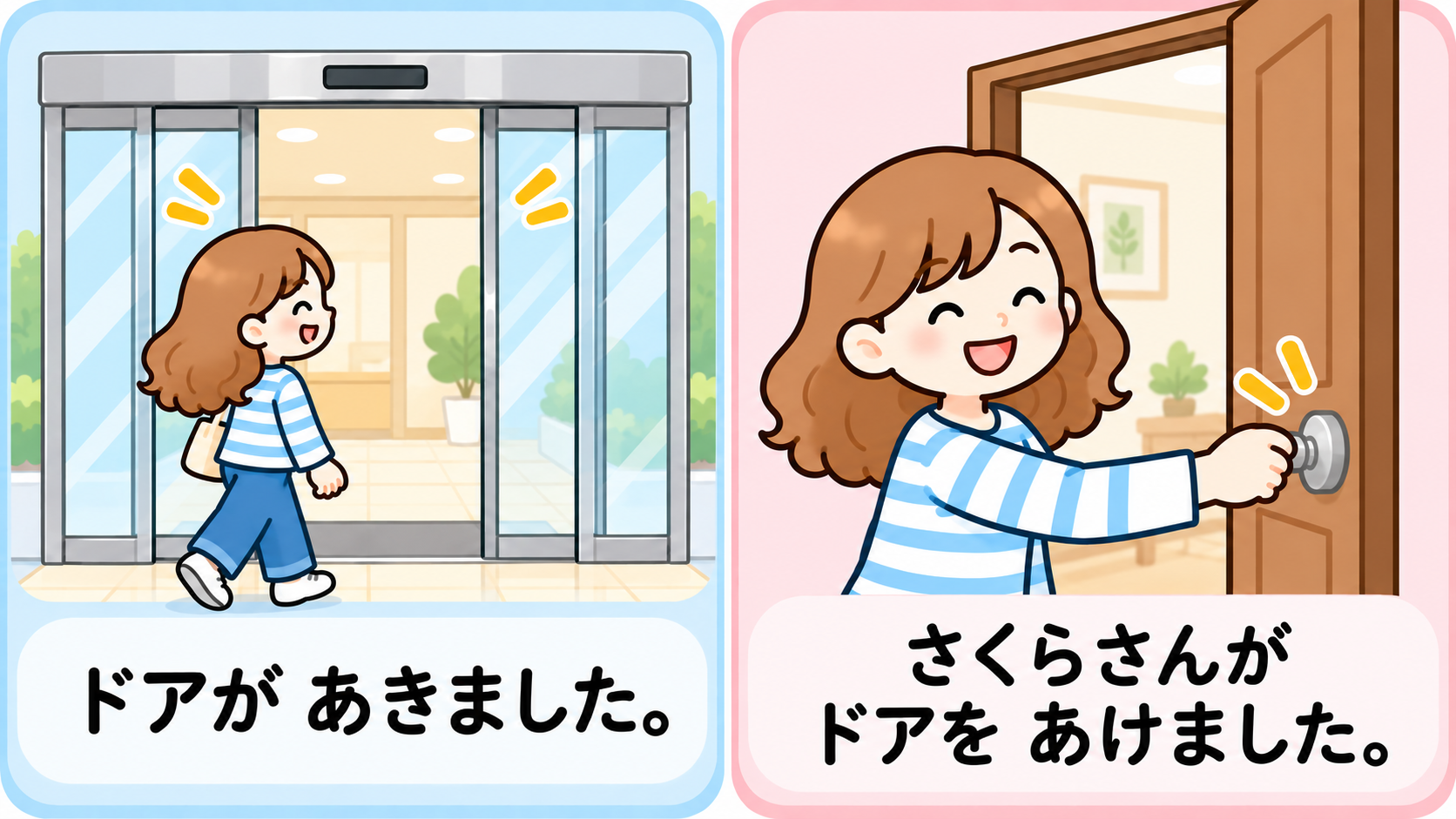
A comparison showing a door opening automatically and Sakura opening a door by hand
WHAT HAPPENED?

ドアが あきました。

The door opened.

あく
WHO DID IT?

さくらさんが ドアを あけました。

Sakura opened the door.

あける
Same kind of change. Different verb.

03

が or を?

Here is a very useful pattern for common transitive and intransitive verb pairs.

A VERY USEFUL PATTERN
INTRANSITIVE
thing が + intransitive verb

ドアが あきます。

The door opens.
TRANSITIVE
person は/が + thing を + transitive verb

さくらさんが ドアを あけます。

Sakura opens the door.
What about は and が?

In everyday sentences, は is very common. が can also appear.

REMEMBER

This is a useful pattern for common verb pairs. It is not a rule for identifying every Japanese verb.

04

Common Verb Pairs

It is useful to learn these verbs as pairs.

INTRANSITIVE TRANSITIVE
あく something opens
ドアが あきます。 The door opens.
↔
あける open something
ドアを あけます。 I open the door.
しまる something closes
まどが しまります。 The window closes.
↔
しめる close something
まどを しめます。 I close the window.
つく something comes on
でんきが つきます。 The light comes on.
↔
つける turn something on
でんきを つけます。 I turn on the light.
きえる something goes off
でんきが きえます。 The light goes off.
↔
けす turn something off
でんきを けします。 I turn off the light.
はじまる something starts
授業じゅぎょうが はじまります。 The class starts.
↔
はじめる start something
先生せんせいが 授業じゅぎょうを はじめます。 The teacher starts the class.
とまる something stops
車くるまが とまります。 The car stops.
↔
とめる stop something
車くるまを とめます。 I stop the car.
こわれる something breaks
パソコンが こわれました。 The computer broke.
↔
こわす break something
パソコンを こわしました。 I broke the computer.
おちる something falls
スマホが おちました。 My phone fell.
↔
おとす drop something
スマホを おとしました。 I dropped my phone.
なおる something is fixed
パソコンが なおりました。 The computer is fixed now.
↔
なおす fix something
パソコンを なおしました。 I fixed the computer.
かわる something changes
よていが かわりました。 The plan changed.
↔
かえる change something
よていを かえました。 I changed the plan.
あがる something goes up
温度おんどが あがりました。 The temperature went up.
↔
あげる raise something
温度おんどを あげました。 I raised the temperature.
さがる something goes down
値段ねだんが さがりました。 The price went down.
↔
さげる lower something
店みせが 値段ねだんを さげました。 The store lowered the price.
はいる someone / something goes in
ねこが へやに はいります。 The cat goes into the room.
↔
いれる put / let someone or something in
ねこを へやに いれます。 I let the cat into the room.
でる someone / something goes out
ねこが へやから でます。 The cat goes out of the room.
↔
だす take / let someone or something out
ねこを へやから だします。 I let the cat out of the room.

05

Do They Always Come in Pairs?

NO.

Not every Japanese verb has a matching transitive / intransitive partner.

For now, focus on the common pairs you meet as you learn Japanese.

06

Can I Guess the Pair?

Sometimes the endings look similar.

はじまる → はじめる
とまる → とめる

These patterns can help, but they are not perfect rules.

It is better to learn common verbs as pairs.

07

Practice

Look at what happens, who does it, and which particle fits the sentence.

WHICH VERB? 1 / 10