GRAMMAR TOOLS
Japanese Giving & Receiving
あげる・くれる・もらう
Japanese has different verbs for giving and receiving, depending on who gives, who receives, and how the speaker views the event.
Later, the same idea also works with actions: 〜てあげる・〜てくれる・〜てもらう
01
Me, My Side & Outside
Japanese often looks at relationships from the speaker’s point of view.
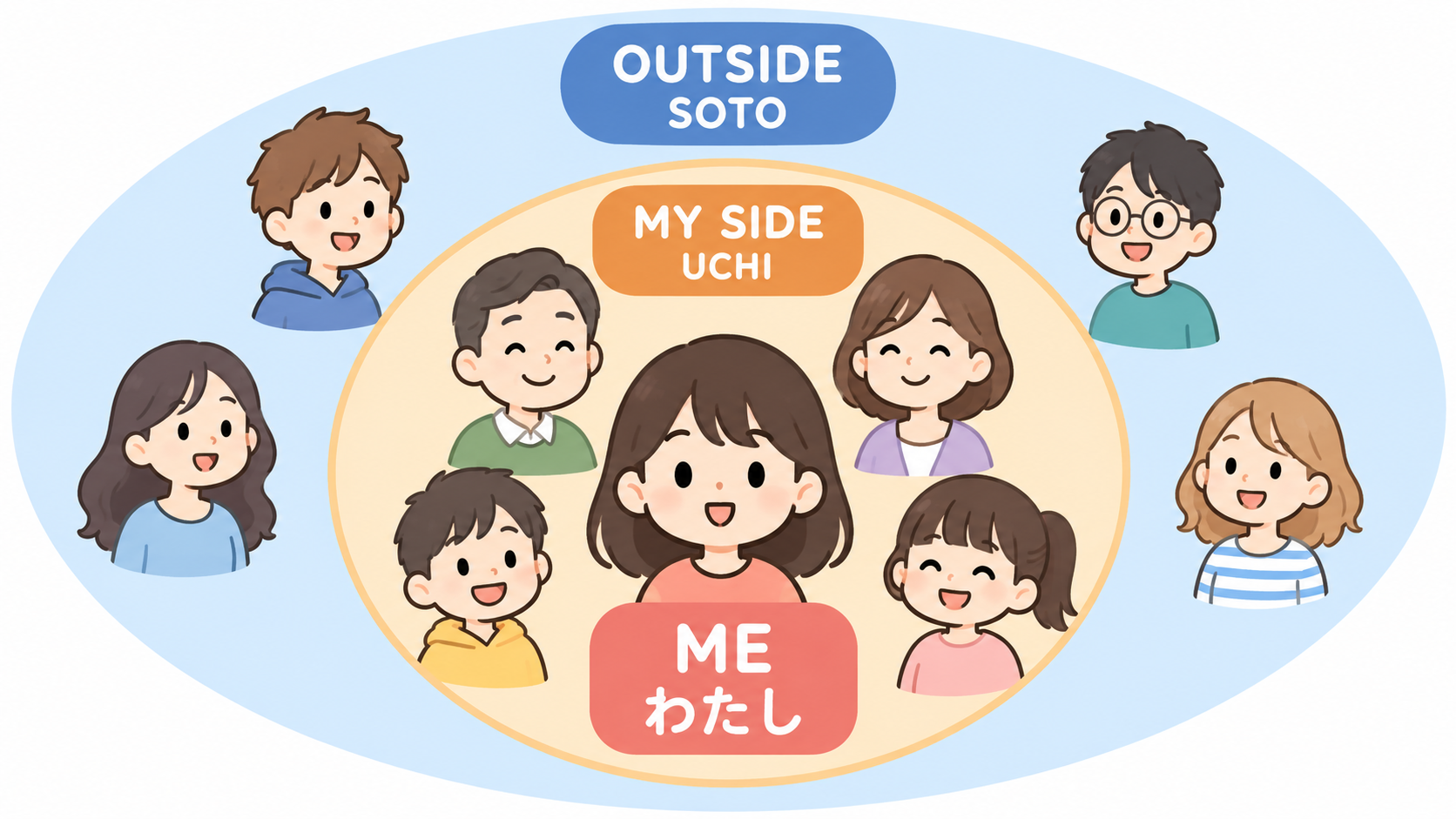
The speaker is the center. Family is an easy example of “my side,” but who belongs to that side can change depending on the situation.
Uchi / soto is a way of understanding the speaker’s perspective — not a fixed rule for choosing a verb.
02
Two Ways to Say “Give”
あげる and くれる both mean “give.” The difference becomes easier to see when you look at who gives to whom.
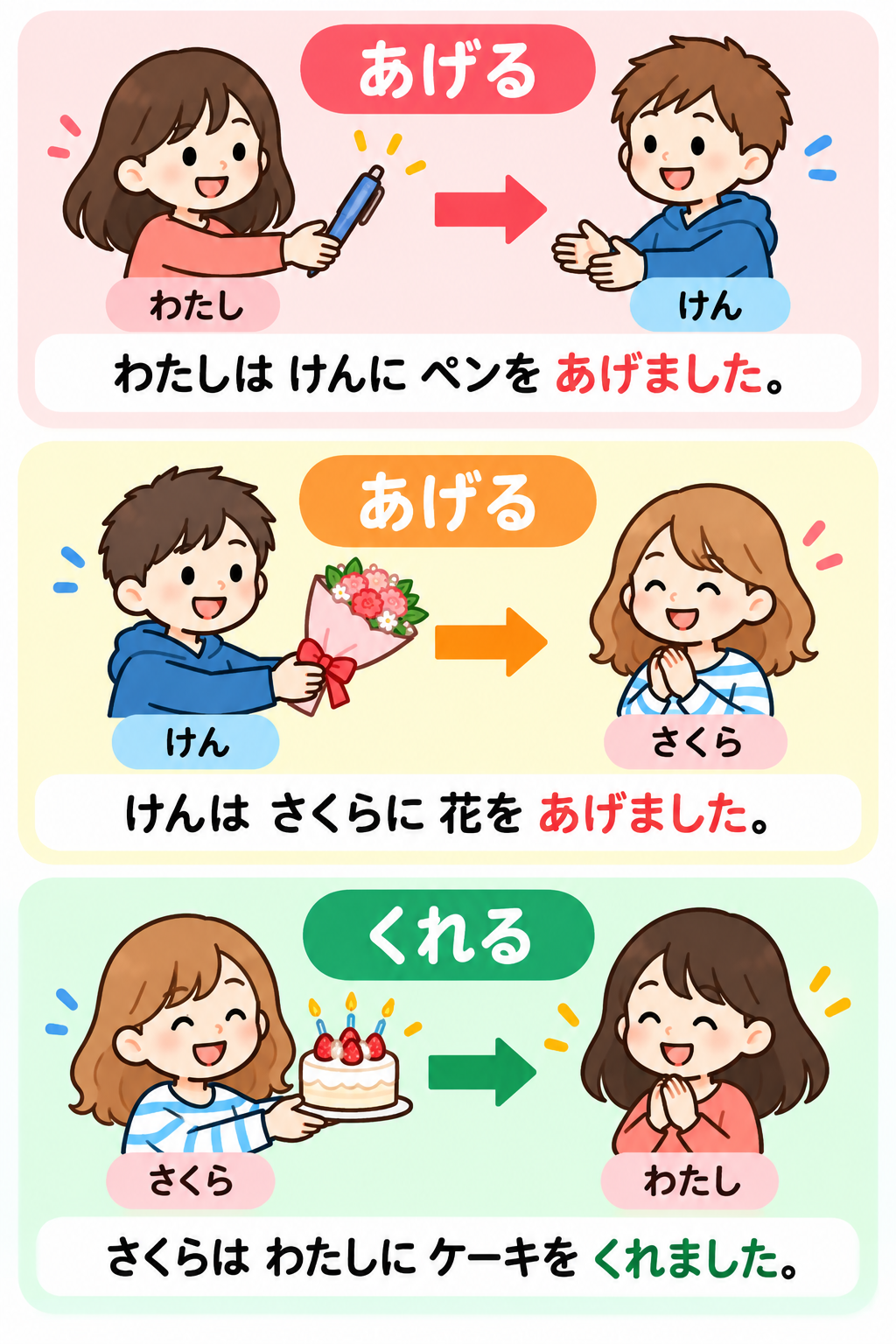
The subject gives something to another person.
あげる can describe ME giving to someone, or one third person giving to another.
Someone gives something to me.
Later, “ME” can sometimes expand to people the speaker sees as being on their side.
03
What about もらう?
もらう means “to receive.” This time, the receiver becomes the subject.
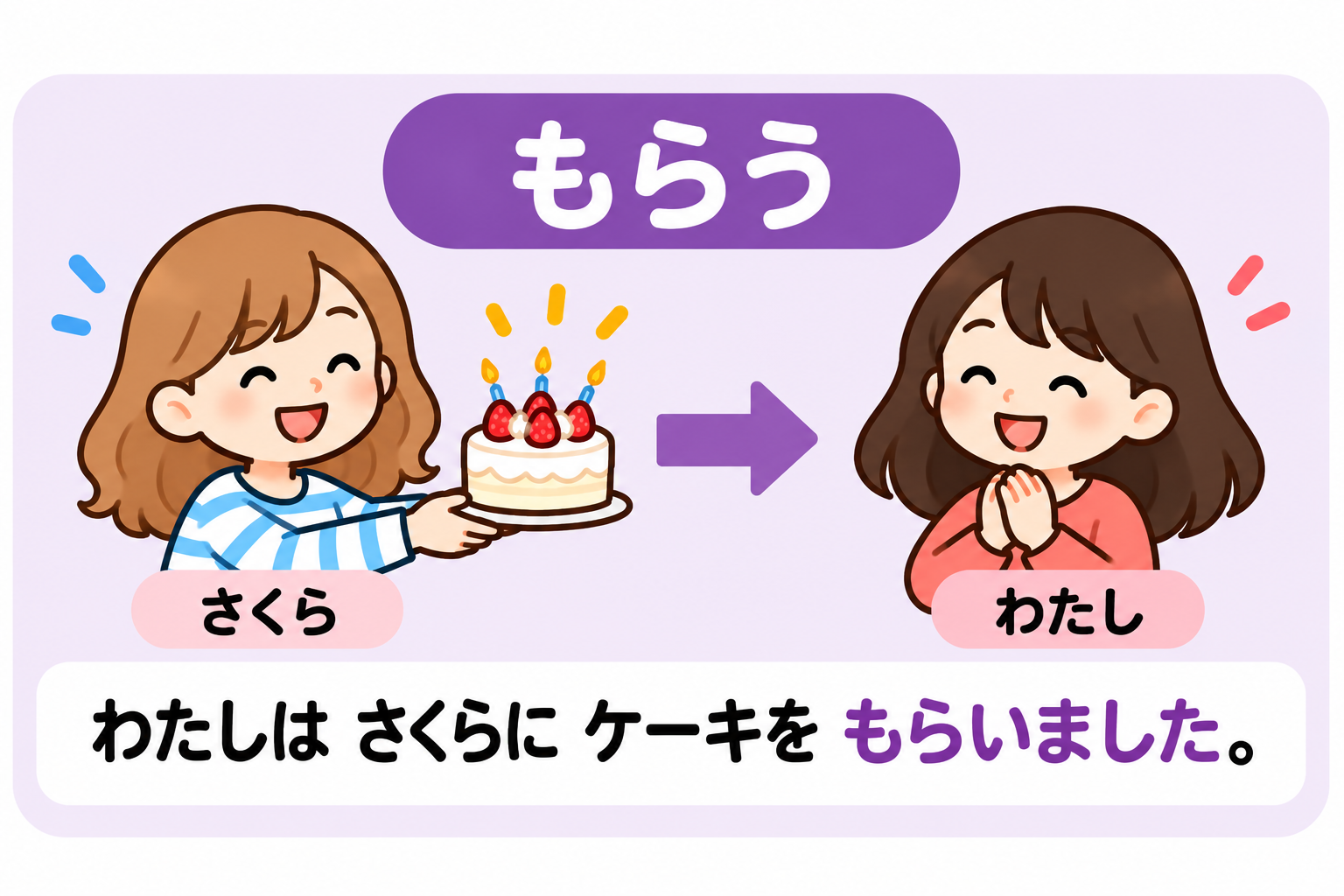
もらう can also describe one third person receiving something from another.
けんは さくらに/から 本をもらいました。
Ken received a book from Sakura.
Both can mark the giver or source. に is very common when the giver is a person. から clearly means “from …”
04
Same Event, Different Subject
Look back at the cake example. The event is exactly the same — only the subject changes.
The event does not change. You simply center the sentence on a different person.
さくらが わたしに ケーキをくれました。
Sakura gave me a cake.
くれるわたしは さくらに ケーキをもらいました。
I received a cake from Sakura.
もらうけんは さくらに 花をあげました。
Ken gave Sakura flowers.
あげるさくらは けんに 花をもらいました。
Sakura received flowers from Ken.
もらうあげる and もらう can also describe an event between two third persons.
This is the “camera” idea: the event stays the same, but the sentence is centered on someone else.
05
What Does “My Side” Mean?
The easiest way to learn くれる is: someone → ME
In some situations, ME can expand to MY SIDE.
For example, a family member or a person belonging to the speaker’s group may sometimes be viewed as part of the speaker’s side.
The relationship depends on the situation and on how the speaker views the people involved.
06
From Things to Actions
The same idea also works when what someone gives you is not a thing, but an action.
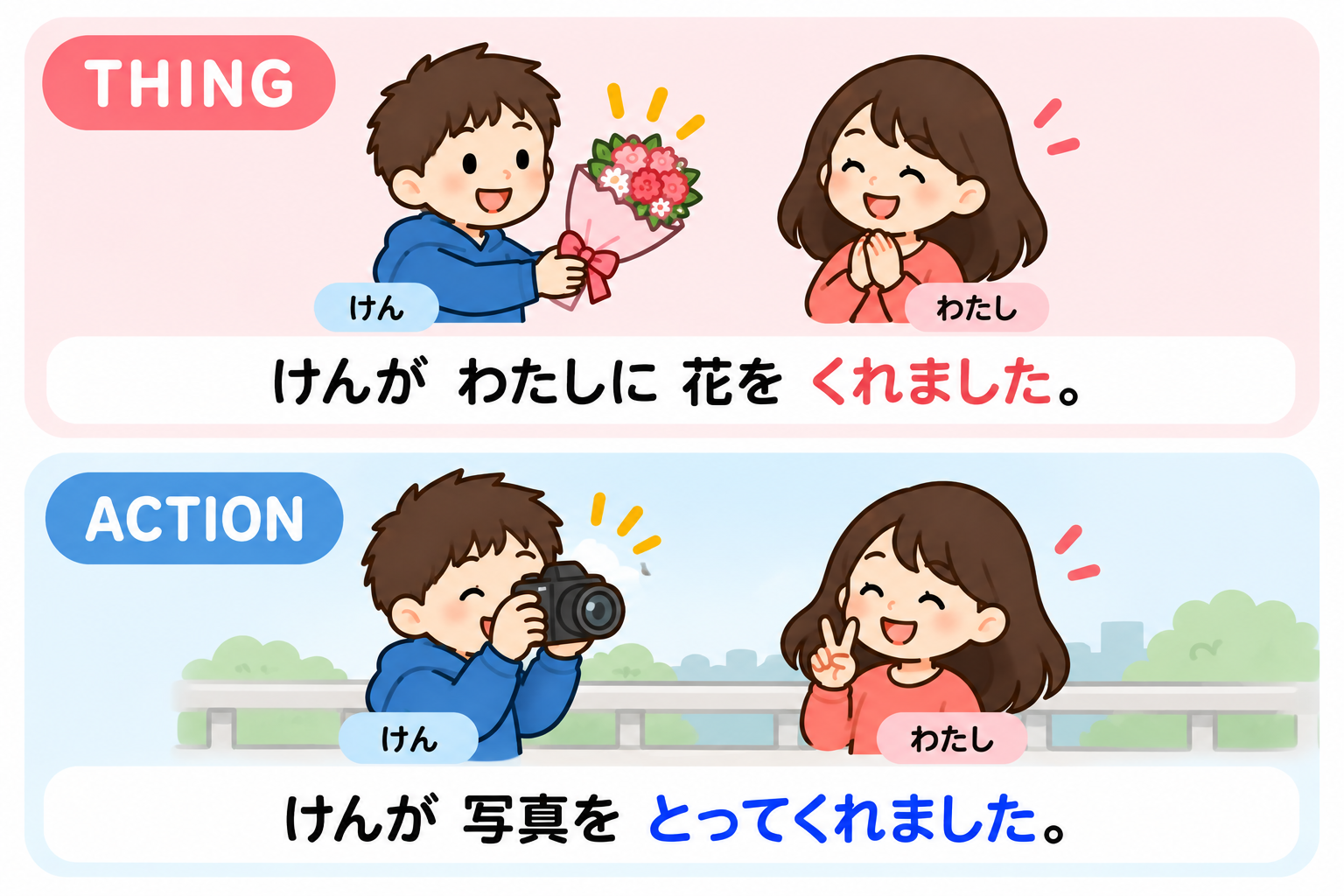
くれる can describe receiving a thing. 〜てくれる describes someone doing an action for you.
Someone does something for another person.
わたしは けんに ばんごはんをつくってあげました。
I cooked dinner for Ken.
Someone does something for me / my side.
けんが 写真を とってくれました。
Ken took a photo for me.
The subject receives the benefit of someone’s action.
わたしは けんに 写真を とってもらいました。
Ken took a photo for me. (I had Ken take a photo for me.)
07
Same Action, Different Subject
〜てくれる and 〜てもらう can describe the same helpful action from different subjects.
けんが 写真を とってくれました。
Ken took a photo for me.
〜てくれるわたしは けんに 写真を とってもらいました。
Ken took a photo for me.
〜てもらうThe situation stays the same. Only the subject changes.
08
Watch Out: 〜てあげる
〜てあげる presents an action as something done for another person’s benefit.
Because of this, using it about your own action can sometimes sound like: “I did you a favor.”
With teachers, customers, superiors, or people you are not close to, it is often safer not to use 〜てあげる about your own action.
09
Practice
Look at the subject and the direction of each event.
Read who the subject is, then choose the correct verb.
SUBJECT: ME
ME → けん
Same event, different subject. Change the sentence below.
Connect the “thing” event to the matching “action” event.
GIVEN SENTENCE
ANSWER