GRAMMAR TOOLS
Japanese Transitive
& Intransitive Verbs
他動詞・ 自動詞
Japanese often has two different verbs for the same kind of change: one describes what happens, and the other describes what someone does.
01
What’s the Difference?
Start with one simple idea.
自動詞
Something happens or changes.
ドアが あきます。
The door opens.
他動詞
Someone does something to something.
さくらさんが ドアを あけます。
Sakura opens the door.
02
Same Situation, Two Sentences
Look at who — or what — is doing the changing.
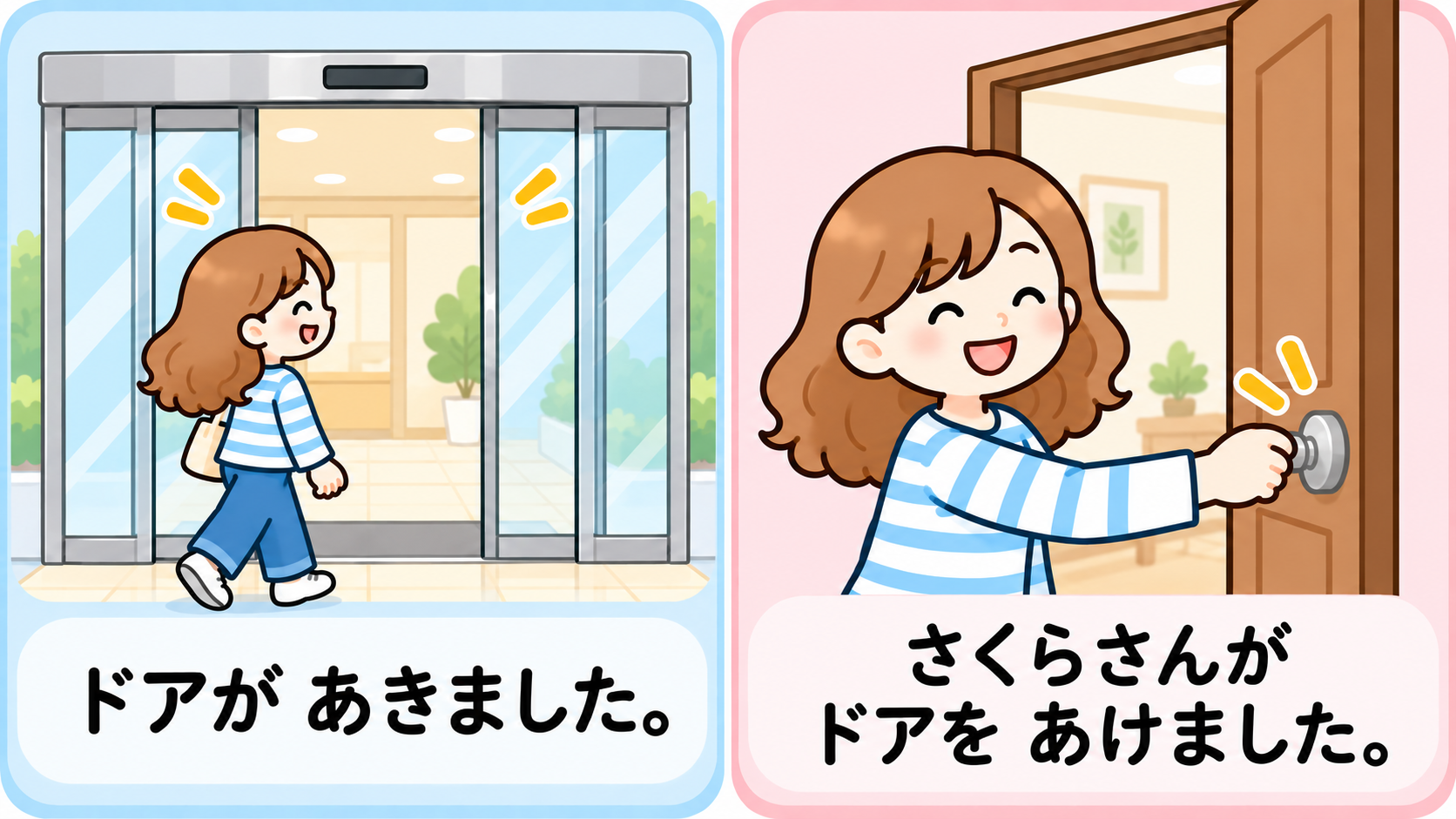
ドアが あきました。
The door opened.
あくさくらさんが ドアを あけました。
Sakura opened the door.
あける03
が or を?
Here is a very useful pattern for common transitive and intransitive verb pairs.
ドアが あきます。
The door opens.さくらさんが ドアを あけます。
Sakura opens the door.In everyday sentences, は is very common. が can also appear.
This is a useful pattern for common verb pairs. It is not a rule for identifying every Japanese verb.
04
Common Verb Pairs
It is useful to learn these verbs as pairs.
05
Do They Always Come in Pairs?
Not every Japanese verb has a matching transitive / intransitive partner.
For now, focus on the common pairs you meet as you learn Japanese.06
Can I Guess the Pair?
Sometimes the endings look similar.
These patterns can help, but they are not perfect rules.
It is better to learn common verbs as pairs.
07
Practice
Look at what happens, who does it, and which particle fits the sentence.